Vibe Directing: What OpenArt Director Actually Does
OpenArt Director generates coherent video up to five minutes long from a conversation. Here is what the feature genuinely changes, what the published pricing does and does not tell you, and the one number OpenArt has not released.
Disclosure, and a limit on what follows: I have a working affiliate relationship with OpenArt. I have not run a client project through Director, so nothing below is a hands-on verdict. It is a read of the published specification, the launch reporting and the pricing, by someone who directs AI video for a living and knows which claims tend to survive contact with a deadline. Where a number matters, I have said where it comes from.
Every AI video tool of the last three years has been a slot machine. You write a prompt, you pull the lever, you get five seconds of something. Then you do it again, because the five seconds you got does not match the five seconds before it.
That is not directing. That is rolling dice and calling the good rolls a style.
OpenArt launched Director in June 2026 with a claim aimed squarely at this problem, and a piece of vocabulary to go with it: vibe directing. The vocabulary is doing a lot of work, some of it useful and some of it marketing. The underlying claim is worth taking seriously.
What vibe directing actually means
The term is lifted from vibe coding, and the borrowing is precise enough to be worth unpacking.
Vibe coding describes writing software by describing intent to a model and iterating on what comes back, rather than authoring every line. You keep the judgement. You hand over the syntax. The skill shifts from knowing the language to knowing what good looks like and being able to say so quickly.
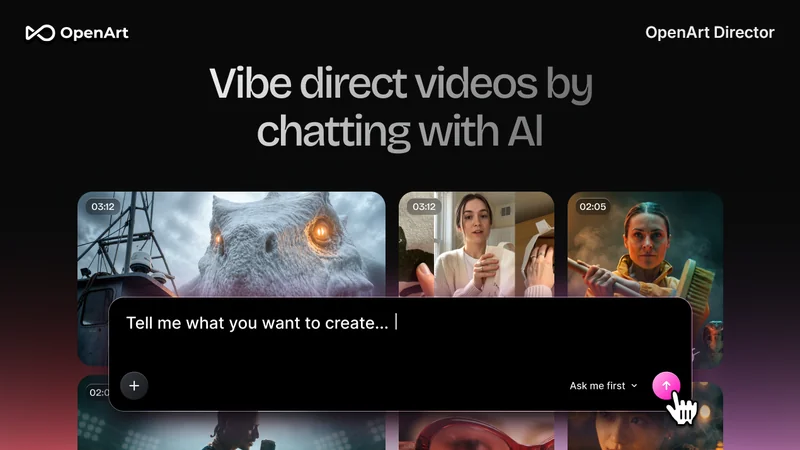
Vibe directing proposes the same trade for film. You do not write shot lists, set up a timeline, or engineer prompts. You describe the feeling, the story, the characters, the environment and the pacing. The system returns a film. You react to it, in words, and it changes.
Coco Mao, who co-founded OpenArt, put the loop plainly to The Hollywood Reporter: "You guide, task, give feedback, and the machine creates. User could forget tools and just imagine, react and give taste."
That last word is the honest one. Taste is what is left when the craft is automated, and taste is not evenly distributed. This is the part of the pitch I would push back on if someone repeated it to me as a business plan. Removing the tooling barrier does not remove the barrier that actually stops most people making good films, which is knowing what a good film is. It lowers the cost of finding out. That is genuinely valuable, and it is a different claim.
Worth knowing who is making it. Mao and co-founder John Qiao are ex-Google engineers who previously built Tangi, a short-form video app incubated inside Google and later absorbed into Google Search. The Hollywood Reporter reports OpenArt at roughly 8 million active subscribers, around $70 million in revenue, about $30 million raised and a headcount of roughly 50. For context, Runway has raised north of $800 million. OpenArt is not trying to win by training a better base model. It is trying to win on the interface layer, orchestrating models it licenses from other people.
The five-minute number is the actual news
Strip the vocabulary away and one specification matters more than the rest.
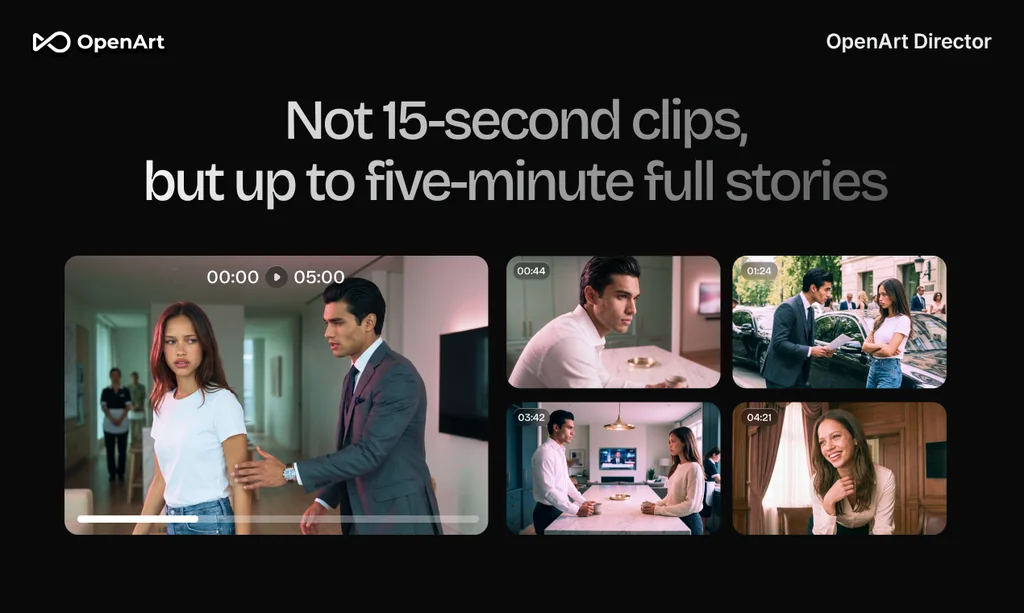
Until now the working ceiling for a single coherent AI generation has been somewhere around 15 seconds. Everything longer was assembled: generate clips, cut them together, and spend your real effort hiding the joins. Director claims coherent output up to five minutes with, in OpenArt's phrasing, "no stitching and no surprises".
Five minutes is not an arbitrary jump. It is the length of a music video, a product film, a short, a micro-drama episode. It is the shortest unit of video that can carry an actual story rather than a moment. Fifteen seconds forces you to make a fragment and hope the platform's algorithm treats it kindly.
If Director holds coherence across five minutes at a quality a client will accept, that is a category change rather than an incremental one. That conditional is carrying real weight, and I will come back to it.
How the conversation runs
The documented workflow has three beats.
You describe the idea in a prompt box, optionally attaching reference images, a soundtrack, voices, or video you already have in your OpenArt library. Director then either asks you a short set of questions about resolution, aspect ratio and tone, or sets those itself. That choice is exposed in the interface as an "Ask me first" toggle, which is a small piece of design I like more than it probably deserves: it is the difference between a tool that assumes and a tool that checks.
From there you talk to an assistant called Ori, shaping characters, story, environment and scenes. Director builds a storyboard scene by scene, and you review that storyboard before anything renders as finished video.
That review gate matters more than the chat does. Approving a storyboard before committing to a render is exactly how human production works, and it is where the money is saved. Reject a bad scene as a still and you have spent almost nothing. Reject it as finished video and you have paid for the render.
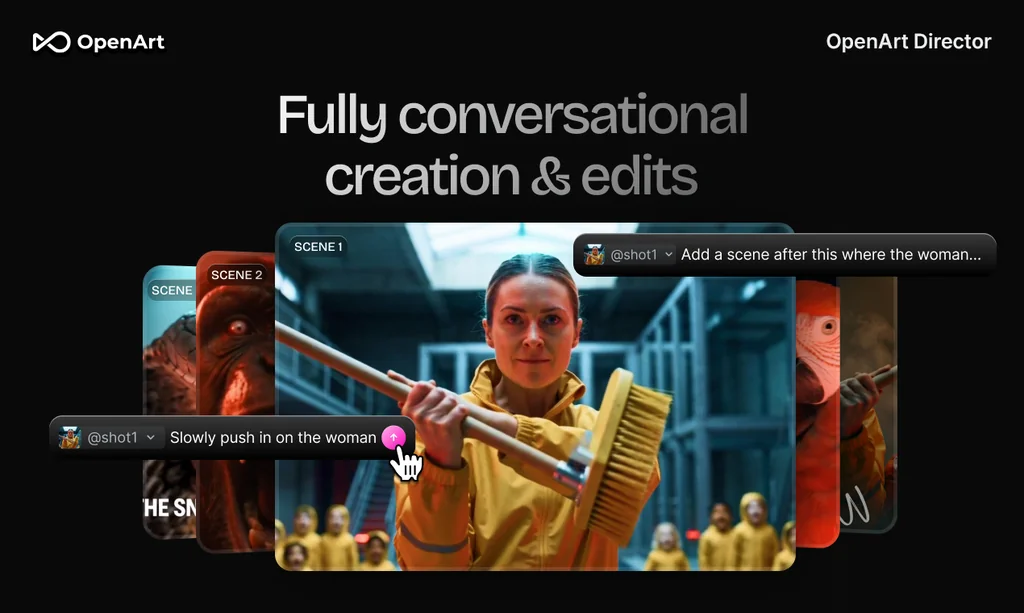
Editing runs through the same conversation. OpenArt's guidance is that you describe a change and Director does "exactly that, nothing more", with no timeline to learn. The launch materials show the granular version of this: shots addressed directly by handle, so you can type something like slowly push in on the woman against @shot1, or ask for a new scene to be inserted after a specific one.
There is also a structured editor for people who want per-parameter control instead of prose. Both paths exist, which is the right answer. Conversation is faster for broad strokes and hopeless for precision, and anyone who has tried to fix a specific frame by describing it in a chat window knows why.
Consistency is the whole game
Length is the headline. Consistency is the feature that makes the length worth anything.
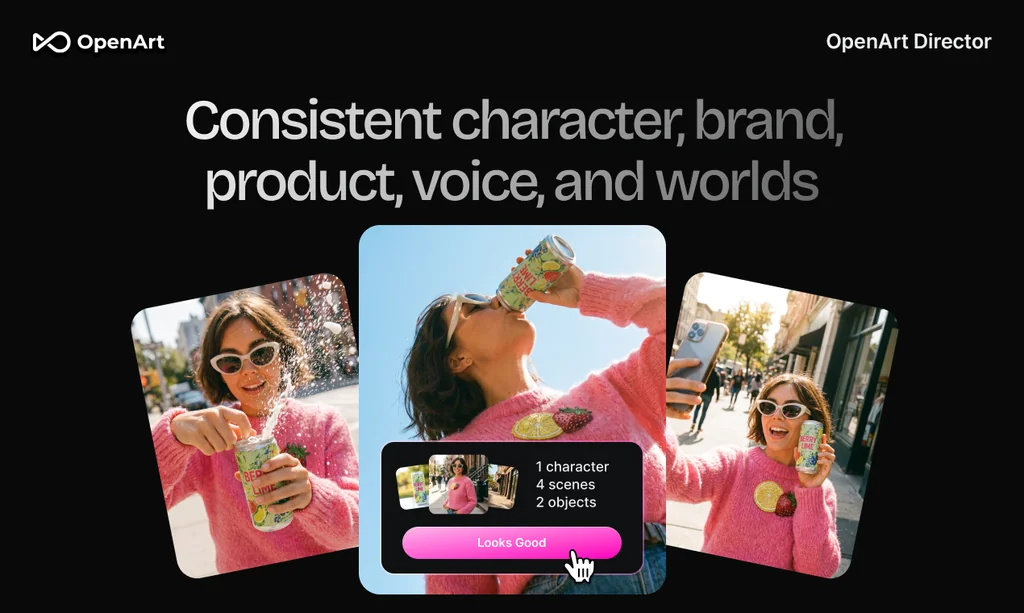
OpenArt's claim is that faces, characters, voices, environments, products, logos and colours hold from the first frame to the last, across arbitrarily complex scenes. Drop several characters in and Director is supposed to track who is who, giving each the right voice and presence.
This is the correct thing to be selling, because it is the specific failure that makes AI video unusable for commercial work. A brand film where the product changes shape between shots is not a rough cut. It is unusable. The same is true of a character whose face shifts, a logo that renders slightly wrong, or a set that rearranges itself between two angles of the same room. Clients do not grade these on a curve.
It is also the claim I would test hardest, and the independent reporting suggests why. Analysis of Director from Kingy AI flags drift as the core risk: "A character, product, location, lighting setup, or voice can drift across scenes even when a preview looks coherent at normal speed." Their recommendation is frame-level review of anatomy, readable text, logos, product geometry, continuity, lip sync and audio artefacts.
That matches my experience of every consistency feature I have used across other platforms. They work, until the shot where they do not, and the failure is usually small enough to miss at playback speed and fatal on a big screen. Watch it frame by frame before you send it.
There is also a hard limit sitting in the pricing rather than the marketing. Consistent characters are capped per tier: around 13 on Starter, around 40 on Plus, rising from there. What OpenArt does not spell out is whether that ceiling is per month, per project or a standing library size, and the difference matters enormously if you are building a recurring cast. Ask their support before you plan a series around it.
Nine languages, and the part nobody is talking about
Director supports English, Mandarin, Cantonese, Japanese, Korean, Spanish, French, German and Portuguese, with what OpenArt describes as phoneme-level lip-sync, "so accurate the story feels made for each audience rather than translated".
This is underrated, and it is where I would look first for real commercial value.
Localising video is brutally expensive by conventional means. You re-record voice, you re-time everything, and either you accept dubbing that visibly does not match the mouth or you pay to reshoot. Most mid-market brands simply do not localise, then wonder why a campaign that worked in one market lands badly in another. Phoneme-level sync across nine languages, generated rather than reshot, changes that arithmetic more than the five-minute ceiling does for most businesses.
I would still have a native speaker check every cut before it ships. Lip-sync accuracy and script quality are unrelated problems, and a well-synced mistranslation is still a mistranslation. It is worth doing well: this is close to the digital human work that removes geography from a production entirely, and it is the capability most likely to pay for the subscription.
What Director runs on
Director is an orchestration layer, not a model. OpenArt's materials name Kling 3.0, Sora 2, WAN 2.7, LTX-2.3, GPT Image 2 and Seedance among the engines available underneath.
Two things follow from that.
First, the sales pitch is honest about what it is. You are paying for direction, consistency and workflow, not for exclusive access to pixels nobody else has. Several of those models are available directly. Kling 3.0 is the one I reach for most on realism and native audio, and it is worth going to Kling itself for. Our own Studio runs a different roster, with per-second pricing published, if what you actually want is a specific model rather than a director.
Second, the roster is a dependency. Director's quality ceiling is set by models OpenArt licenses, and its cost floor is set by what those models charge. That is a reasonable position for a company with $30 million raised rather than $800 million. It is not a moat.
What it costs, and the number OpenArt has not published
List pricing at the time of writing, billed monthly:
| Plan | Monthly | Credits / month | Videos (OpenArt's estimate) | Commercial use |
|---|---|---|---|---|
| Starter | $14 | 4,000 | ~50 | Not included |
| Plus | $34 | 12,000 | ~150 | Included |
| Pro | $56 | 24,000 | ~300 | Included |
| Wonder | $240 | 106,000 | ~1,300 | Included |
Annual billing takes up to 27% off those figures. Extra credits run $15 per month for 5,000, and require Plus or above. All four paid tiers are watermark-free, and all four include Director. If you have read elsewhere that Director is gated to the higher plans, that was true of an earlier tier structure and is not true of the one OpenArt is currently selling. Check the pricing page before you buy, because this moves.
Two details in that table deserve to be pulled out.
Commercial use starts at Plus, not Starter. The $14 plan is watermark-free, which reads like permission and is not. If the video is going anywhere near a client, a product or a paid channel, your entry price is $34 rather than $14. Read your own licence rather than my summary of it, but do read it.
Nobody has published what a Director minute costs. This is the gap, and it is a real one. OpenArt publishes credits per month and an approximate video count per tier, but no per-second, per-scene or per-minute Director rate. The video counts assume a baseline model, and premium video models consume considerably more. So the two headline numbers cannot be reconciled from anything published: you cannot work out from the pricing page how many five-minute films 12,000 credits buys, and the honest answer might be one.
I am not accusing anyone of hiding it. Orchestrated pipelines have genuinely variable costs, and a fixed rate card would be a lie in the other direction. But it does mean the "~150 videos" on the Plus plan tells you almost nothing about Director specifically, and you should assume the five-minute ceiling is a technical capability rather than a monthly allowance.
The practical consequence: treat your first project as the measurement rather than the deliverable. Build one representative piece, five scenes, with the revisions a real job would need, and read your credit balance before and after. That number is your actual price. Everything before that is an estimate. It is the same discipline behind our own credit cost guide, and the reason we publish per-second rates rather than video counts.
Time-boxed as of 30 July 2026: OpenArt is running up to 40% off top models through December, with the subscribe-by date set at 31 July. If you are reading this after that, assume it has expired and price from the table above. Annual billing's 27% discount is the standing offer.
Where it is weak
Three things I would want resolved before putting this near a paying client.
The scripts. The Hollywood Reporter's reporter, testing Director directly, found initial script generations "rudimentary" and needing substantial rewrites. That tracks with every text-to-story system I have used. Structure comes out competent and generic, because a model trained on everything defaults to the middle of everything. Bring your own script. The tool is a director, not a writer, and treating it as both is how you end up with five technically flawless minutes that nobody wants to watch.
Drift at length. Coherence across five minutes is the central claim and the hardest thing in this field. It is also the claim most likely to be true on average and false on the shot you need. Longer output means more surface area for a small failure to hide in.
The precision question. The Hollywood Reporter raises whether conversational direction suits work that requires exactness, and it is a fair challenge. Some briefs are a feeling. Others are: the logo is this Pantone, the bottle is this shape, the actor's eyeline goes here. Prose is a poor instrument for the second kind. The structured editor exists for exactly this, and how good it is will decide whether Director works professionally or stays a very impressive way to make things for yourself.
Who should actually buy it
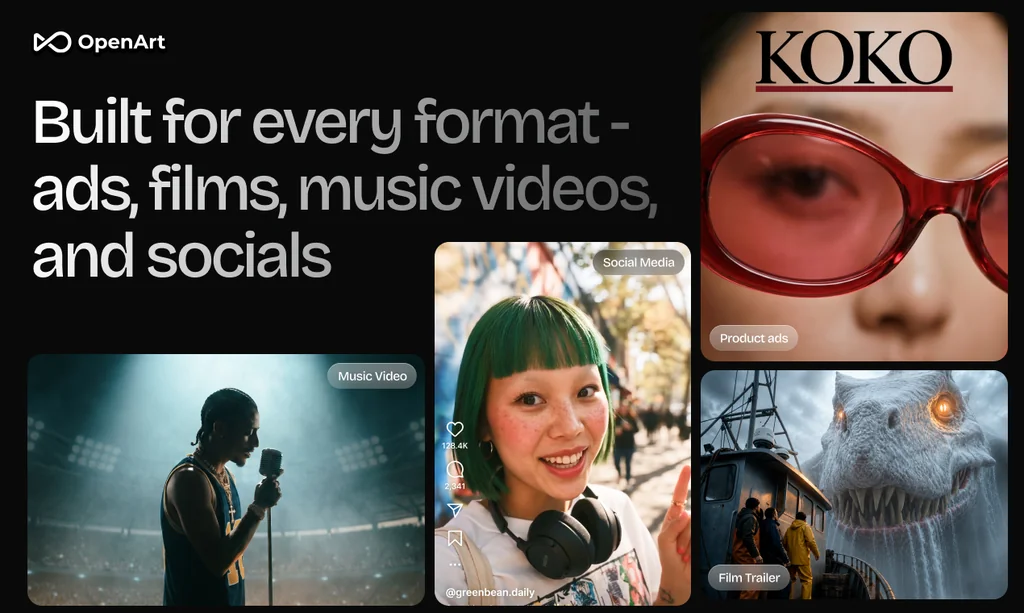
Director ships templates for short films, film trailers, music videos, micro-dramas, product ads, branding ads, UGC ads, social content and explainers. That is a wide net. Here is my read on where it lands.
Buy it if you have stories you cannot currently make. Solo creators, micro-drama producers, musicians who need a video and have no budget for a crew, small brands who need a product film and have been quoted five figures. If the alternative is not making the thing at all, $34 a month against a five-figure quote is not a close decision. The friction reduction is the product, and one early user quoted by The Hollywood Reporter put it exactly right: "Feel more creative because removing friction."
Buy it cautiously if you need multilingual versions of video you already produce. The lip-sync capability is the strongest commercial argument here. Test it on one asset in one language before you plan a campaign around it.
Do not buy it expecting to skip the judgement. Vibe coding did not make everyone a software engineer. It made people who already knew what good software looked like considerably faster, and gave everyone else a much quicker route to something broken. This will run the same way. If you cannot tell whether a cut is working, a tool that generates cuts faster is not going to help you.
And if what you actually need is a finished film to a brief, with someone accountable for whether it works, that is not a subscription. That is a production, and I would rather tell you that than sell you a monthly fee you will not use.
Where this goes
The vocabulary will probably stick, because it describes something real. A generation of people are going to make their first film by talking to a machine, and some of them are going to be extremely good at it, in the same way some vibe coders turned out to be excellent product thinkers who had simply never learned a language.
What I do not believe is that the craft disappears. Five minutes of coherent output means five minutes of decisions: where the cut falls, how long a look holds, when the music drops. Director generates a competent default for all of it. Competent defaults are exactly what gets a film ignored.
The tool is genuinely interesting, the length claim is the most significant thing anyone has shipped this year in this category, and the pricing has an unpublished number at the centre of it that you should measure yourself before you scale anything.
Try Director on the free trial and put one real project through it. Then read your credit balance. That number, not the specification, tells you whether it belongs in your workflow.
If you would rather commission the finished thing, tell me what you need or look at how we build video for clients. We use tools like this. We do not hand you the subscription and call it a deliverable.
Generate cinematic AI video — from €15
Five frontier models. No subscription. Buy credits, generate on demand, own the results outright.