AI Commercial Production: Make It Yourself or Have It Directed?
Polished AI commercials pair generated footage with human direction: a director designs every shot and keeps the few takes that hold together. As of October 2026, published prices for a directed AI video run from about €1,000 to five figures, with MAW AI Studios from $1,500, Lemonlight from $5,000 and ours at €995 and €2,995. Make drafts and volume social yourself; have anything that carries your brand in paid media directed.
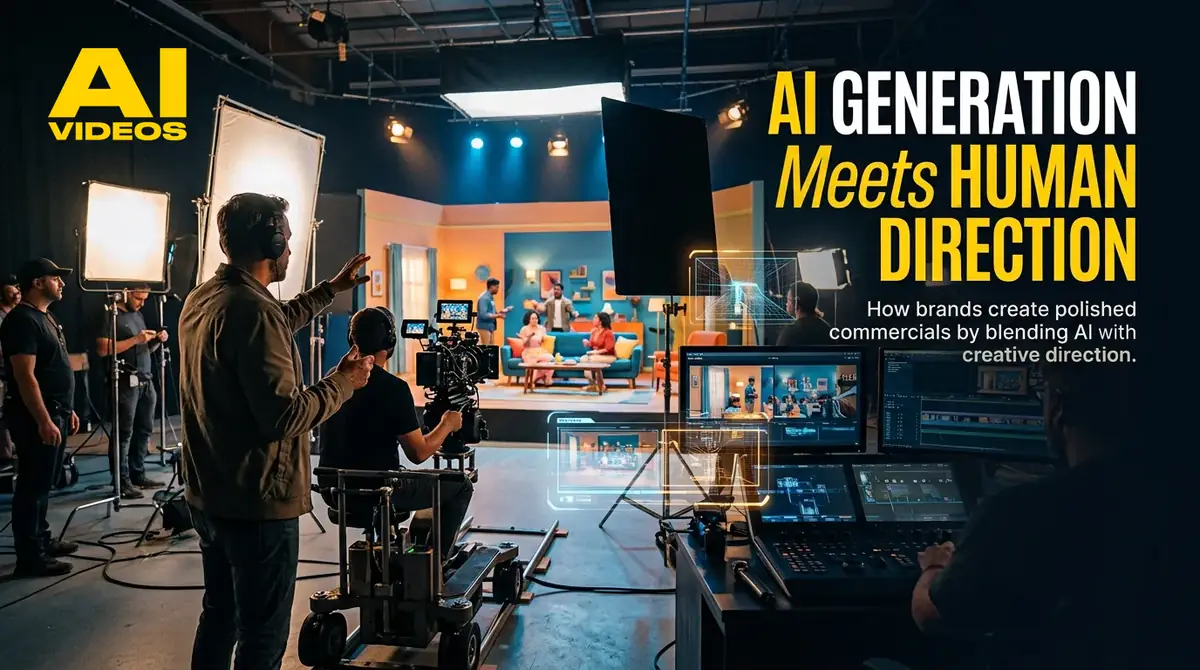
A polished AI commercial is generated by machines and decided by people. The models produce stills and short clips. A director decides what the film is, designs each shot, and throws most of the output away.
That last part is what a production fee mostly pays for, as the Kalshi numbers further down show.
This post answers three questions buyers keep asking: how that combination actually works, what a realistic budget looks like as of October 2026, and when you should make the video yourself instead of hiring anyone. Every market figure below links to a page I opened on 7 October 2026. Our own prices come straight from our pricing page, and the full source list is at the end.
The Short Answers
- How it works. AI speeds up the making. Direction decides the choosing: which idea, which shot, which take, which cut.
- What it costs. Published prices for a directed AI video run from about €1,000 to five figures. MAW AI Studios starts at $1,500, Lemonlight at $5,000 for 30 seconds, and our directed packages are €995 and €2,995.
- Yourself or a team. Usually both. Drafts, tests and organic social you can make yourself. Paid media, your homepage and anything with a real person on screen deserve a director.
- The line item people forget. Since 2 August 2026, some AI content in EU advertising needs a clear label. Decide that at the brief, not at launch.
How Companies Combine AI Generation With Direction
Brands use AI to generate the footage and people to make every decision about it. A director sets the idea and designs every shot, the models generate many takes of each, the director keeps the few that hold product and character continuity, and the film is then edited, graded and mixed like any commercial. Only the generation step is new.
The best-known public example is Coca-Cola's 2025 "Holidays Are Coming" film. By Coca-Cola's own account, in a making-of video reported by TheWrap, a team of five AI specialists sorted through more than 70,000 clips in 30 days. TheWrap described a workflow that ran from prompting for static images, to animating them with image models, to post-production for colour tweaks and clean-up. A voice in Coca-Cola's own making-of video, as quoted by TheWrap, put it this way: "That level of precision suggests the team had to go way beyond just simple prompting." TheWrap added that some viewers wondered whether those voices were AI-generated too.
A much smaller job shows the same shape. Business Insider reported in June 2025 on the ad that filmmaker PJ Accetturo made for the prediction market Kalshi during the NBA Finals. It went from idea to live ad in three days. He used chatbots to turn the script into a shot list and structured prompts, generated the footage with Google's Veo 3, and said he typically has to run the process 20 to 30 times to fine-tune the nuances. Veo 3 produced the voices and sound effects along with the picture, rendering everything in what he called "one shot".
Why so much selection? Partly because of how the tools are built. Google's documentation for Veo 3.1 lists clip lengths of 4, 6 or 8 seconds, with 1080p and 4K output available only at 8 seconds. Veo can extend a clip in 7-second steps, but only at 720p. So a 30-second spot at 1080p is at least four separately generated shots, and in practice far more, because commercials cut. Every one of those shots is its own gamble on faces, hands, product shape and light. Somebody has to make them look like one film.
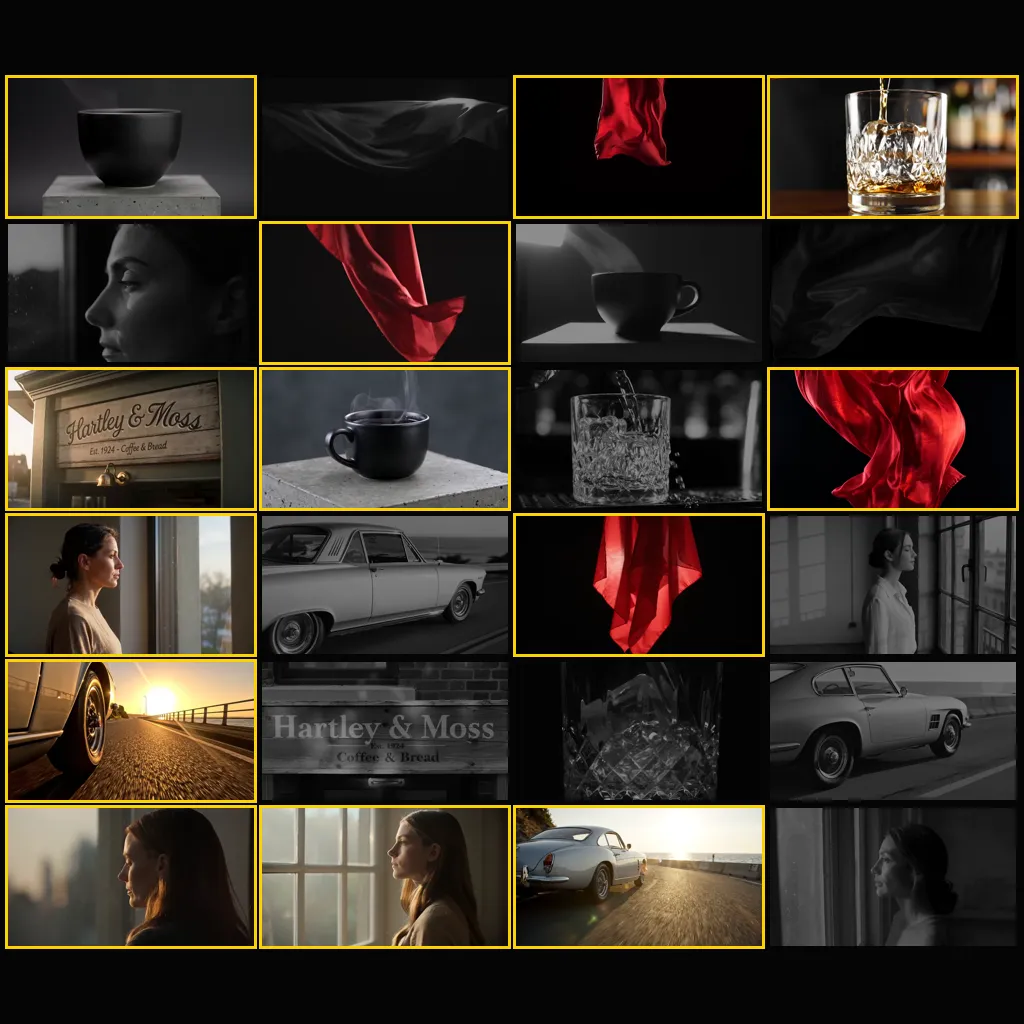
I put a number on that gamble in my own testing. I rendered the same six commercial shot briefs on eight models, 48 clips in all, and only 13 were good enough to show a client (the full 48-render comparison). No model delivered all six shots. Choosing the right model for each shot is a directing decision, not a software setting.
Coca-Cola's making-of film, as quoted by TheWrap, put the shift neatly: "Post-production is the new pre-production." Planning has not gone away. It has moved earlier and become visual, so a client now approves frames they can see rather than a paragraph in a deck.
The Hybrid Workflow, Stage by Stage
A directed AI commercial runs through the same stages as any other. At each one, the work divides between the machine and the people.
| Stage | Where AI speeds it up | What the director decides |
|---|---|---|
| Idea | Many angles on a brief in minutes | Which idea is true to the brand and worth making |
| Treatment | Mood frames and reference looks, fast | Tone, story, what the viewer should feel |
| Script | Draft lines and alternatives | What gets cut, and timing to the second |
| Storyboard and style frames | Image models turn boards into near-final frames | Composition, palette, and sign-off on the look before any video is generated |
| Shot design | Very little | Lens, light, camera move, shot length, and which engine suits each shot |
| Image generation | Keyframes for every shot | Which frames hold continuity of product, character and wardrobe |
| Image-to-video | The engine adds motion | Which takes survive, and which get rerun for warped logos, bad hands or broken physics |
| Voice and audio | Voice drafts and generated sound | Casting the voice, the mix, and music the client can actually use |
| Edit | Little that matters | Rhythm, cut points, and what the story leaves out |
| Colour | Little that matters | Matching shots from different engines into one grade |
| Delivery | Fast exports | Formats, cutdowns, labelling, and the rights paperwork |
AI is strongest in the middle of the pipeline, where pictures and motion used to cost a crew and a shoot day. Every stage still ends with a human choice the model cannot make, because the model does not know your brand, your audience, or what was agreed in the brief meeting.
The selection rows are where the hours go. Accetturo says he typically runs the process 20 to 30 times to get the nuances right. I would expect more on a polished brand film, because the bar for a homepage hero is higher than the bar for a topical social spot.
On directed projects we choose the engine per shot rather than by habit: Kling for cinematic motion, Seedance for long single takes, Veo for native dialogue and sound, with Runway for specific jobs. That routing is part of what a production fee pays for. The deeper mechanics of each stage are in our AI video production workflow guide, and the shot vocabulary that makes prompts behave is in AI video prompt engineering.
What Is a Realistic Budget for a Professional AI Video?
As of October 2026, published prices for a directed AI video run from about €1,000 to five figures. MAW AI Studios lists a 15 to 60 second spot from $1,500, Lemonlight a 30-second brand video from $5,000, and Business Insider reported that the filmmaker behind Kalshi's AI ad charges five-figure fees. For comparison, Lemonlight puts freelance work at $500 to $5,000 a project and traditional crewed production at $15,000 to $50,000 or more. Our own directed packages are €995 and €2,995.
Most of the published figures are American and in dollars, so treat them as reference points rather than a European rate card. The table sets them side by side; the two euro rows are ours.
| Route | Published price | Who makes the decisions | Source |
|---|---|---|---|
| Freelancer (Lemonlight's estimate) | $500 to $5,000 per project | Varies widely | Lemonlight, March 2026 |
| Our Director's Cut, 15 to 20 seconds | €995, 5 to 7 working days | A director | Our pricing |
| MAW AI Studios, single spot of 15 to 60 seconds | From $1,500, 5 to 10 business days | The studio | MAW AI Studios |
| Our Brand Campaign, one 60s film or three 15s films | €2,995, 5 to 7 working days | A director | Our pricing |
| Lemonlight, expert-led, 30 seconds | From $5,000 | Lemonlight | Lemonlight, March 2026 |
| Traditional crewed production (Lemonlight's estimate) | $15,000 to $50,000+ per video | A production company | Lemonlight, March 2026 |
If you are making the video yourself, the Studio charges per render rather than per project; the middle route further down covers how that works.
Lemonlight describes its own expert-led 30-second AI video as roughly 60% less than traditional production. That is a vendor talking about its own service, so weigh it as one.
What the fee actually pays for
The Kalshi ad is the most useful data point I found. Business Insider reported production costs of about $2,000, and that Accetturo charges clients five-figure fees.
The gap between those two numbers is the job. Concept, writing, shot design, hours of selection, and the judgement to stop when a take is right. Generation is cheap now. Knowing what to generate is not.
So "AI makes video cheap" is only half true.
Our own packages, exactly as published on the pricing page:
- Director's Cut, €995 per project. A 15 to 20 second cinematic film with full creative direction and storyboard, 4K delivery with a cinematic grade, commercial usage rights and two revision rounds, delivered in 5 to 7 working days.
- Brand Campaign, €2,995 per package. One 60-second film or three 15-second films, creative strategy and storyboarding, a 4K master plus social formats, an extended commercial licence and five revision rounds, also in 5 to 7 working days.
- Studio Retainer, tailored. Monthly volume with dedicated creative direction and a 48-hour turnaround on briefs.
Every package starts with a creative brief consultation at no extra cost, and every delivery comes with a signed rights document. Full inclusions are on our pricing page; to scope a project, send us a brief.
What pushes a budget up
- Shot count. Length matters less than the number of distinct shots, because each one is generated, selected and matched separately. The raw generation cost per shot is in what each model costs per second.
- Real people. A recognisable person, a spokesperson's likeness or lip sync to real dialogue adds consent, continuity and labelling work.
- Product accuracy. Packaging, logos and on-screen text are where models slip. In our 48-render test only one of eight models delivered the shop-sign shot as briefed, and several that spelled the sign correctly put it in the wrong place, so brand-critical text usually goes in during the edit.
- Versions. Cutdowns, aspect ratios and languages each add edit and checking time.
- Revision rounds. Consolidated rounds keep cost predictable. Open-ended feedback does not.
- Speed. Our standard is 5 to 7 working days from brief sign-off, with rush (48h) available on request.
- Usage. Paid media, broadcast, sub-licensing and agency use widen the rights you need.
For briefing and review from the marketing team's side, see our AI video for brands guide.
Should You Make Marketing Videos Yourself or Hire a Team?
Usually both, split by asset. Make drafts, tests and high-volume organic social clips yourself, and have anything that runs in paid media, on your homepage or with a real person on screen directed, because continuity, finish and rights decide whether it works.
Whether AI is involved at all is rarely the question any more. Wyzowl's 2026 survey found 63% of video marketers say they have used AI video tools to help create or edit marketing videos, up from 51% the year before. The IAB's 2025 video report found 86% of ad buyers using or planning to use generative AI to build video ad creative, and buyers projected it would reach 40% of all ads by 2026. That last figure was a forecast made in 2025, not a measurement.
So most video marketers already use the tools. What differs is who steers them.
There is one piece of research every brand should read before deciding. NIQ's study, released in December 2024 with more than 2,000 participants watching AI-generated ads of varying quality, found consumers described them as more "annoying," "boring" and "confusing" than traditional ads. Even the ones perceived as high quality produced weaker memory activation in the brain. That is the strongest argument I know against treating AI as a shortcut. AI footage starts at a disadvantage with viewers. Story, pacing and sound have to win attention back.
Here is how I would split the work.
| Situation | Make it yourself | Have it directed |
|---|---|---|
| Where it runs | Internal decks, organic social, tests | Paid media, your homepage, broadcast, a launch |
| A real or recognisable person on screen | Avoid | Yes, with consent and labelling handled |
| Many shots that must match | One to three loose shots | A sequence that has to hold continuity |
| Volume | Lots of quick variations | One hero piece plus planned cutdowns |
| Deadline | Today, rough is fine | A date you cannot miss, at full finish |
| Brand or legal risk | Low | Anything a complaint could reach |
| What you want to keep | A skill your team can repeat | A film you can run for a year |
The hidden cost of doing it yourself is selection time, not credits. In our 48-render test, rendering every model on every shot cost $50.89 in provider charges. The cheapest usable clip for each of the six shots, picked in hindsight, came to $5.02. The difference is the price of not yet knowing which model handles which shot. You pay it once per shot type, in money and in afternoons. Our guide to not wasting AI video credits shows how to test cheap before you render dear, and the Render Ledger keeps current provider prices per second.
The middle route
The route I would recommend to most teams is doing both on the same project. Rough out the idea yourself, see what works, then hand the hero piece to a director with frames already in hand. A brief with pictures attached is faster to scope and harder to misread.
That is how the Studio is meant to be used. Credit packs start at €15 for 440 credits, with no subscription, and credits never expire. A 5-second 2K clip on MiniMax H3, the mid-priced model our pack values are counted in, costs 33 credits, and an image on Flux 2 Pro costs 3. Paid output is watermark-free with full commercial rights. The Prompt Director, at 1 credit a pass, turns a rough idea into a shot brief written for the model you picked. It puts some direction into the do-it-yourself route. It does not replace taste, and it will not tell you which of twenty takes is the one.
I have spent more than 25 years in photo editing and creative design, for clients including the Cannes Film Festival, Dell and Bosch, and the briefs I find quickest to work from are the ones that arrive with rough frames attached. If you are weighing agencies, how to choose an AI video agency covers what to ask before you sign, and AI video agencies in the UK and US compares the market.
Rights and Labels Belong in the Budget
Neither of the pricing pages cited above mentions labelling. It now belongs in the budget.
EU labelling. As Lewis Silkin set out in July 2026, from 2 August 2026 Article 50(4) of the EU AI Act can require businesses that use AI-generated visual or audio content professionally to label it when it counts as a deepfake. The disclosure has to be "clear, distinguishable and understandable to the audience" and appear "when the content first reaches its audience". Genuinely fantastical content falls outside the test; their examples are "dragons, or elephants driving cars". Their practical advice is to "agree early in the creative process what label to apply". That fits the workflow above: the label is a delivery decision, so it belongs in the brief.
UK advertising rules. The ASA's position, as summarised by Lewis Silkin in June 2026, is that "Ads created using AI are subject to the same rules on misleadingness, offence and social responsibility as any other marketing content." The advertiser stays accountable, whoever or whatever made the ad.
Copyright. In the US, the Copyright Office published its report on copyrightability on 29 January 2025. As Hogan Lovells Cadwalader summarised it, the report concludes that "guiding AI output using prompts does not generally meet the threshold of creativity required for copyright protection". Creative selection and arrangement of AI output, and human input that remains perceptible, can be protected. That is a legal argument for direction as well as a creative one: the human choices are the part that can be owned. UK law takes a different approach, which I have not covered here, so take advice for your market.
None of this is legal advice. It is a reason to ask any supplier, us included, what rights you get in writing. Ours come as a signed rights document with every delivery.
Where This Guide Stops
- Dollar figures stay in dollars. I have not converted them, because a rate on the day would be one more number to go stale.
- Some sources sell the thing they price. Lemonlight and MAW AI Studios publish their own prices, and Lemonlight's freelance and traditional ranges are its own estimates. Useful, and still vendor pages.
- No marketplace rates. I could not verify current hourly rates on the big freelance marketplaces, so none appear here.
- One test, one judge. The 48-render figures come from one take per model per shot, judged by me.
- Law moves. The labelling rules above are summarised from law firm briefings dated mid-2026. Check the position for your market and date.
Questions Buyers Ask Before Commissioning
How do companies combine AI video generation with professional direction? A director sets the idea and designs each shot, AI models generate many takes of every shot, and people choose the few that survive before the film is edited, graded and mixed like any commercial. Coca-Cola's 2025 Christmas film is the best-known public example: by the company's own account, five AI specialists sorted more than 70,000 clips over 30 days.
What is a realistic budget for a professional AI-generated video? As of October 2026, published prices for a directed AI video run from about €1,000 to five figures. MAW AI Studios lists a 15 to 60 second spot from $1,500, Lemonlight a 30-second brand video from $5,000, and Business Insider reported that the filmmaker behind Kalshi's AI ad charges five-figure fees. Lemonlight puts freelance work at $500 to $5,000 a project and traditional crewed production at $15,000 to $50,000 or more. Our directed packages are €995 for a 15 to 20 second film and €2,995 for a campaign, each delivered in 5 to 7 working days.
Should I make marketing videos myself with AI or hire a production team? Usually both, split by asset. Make drafts, tests and high-volume organic social clips yourself, and have anything that runs in paid media, on your homepage or with a real person on screen directed, because continuity, finish and rights decide whether it works.
Do AI-generated ads need a label in the EU? Some do. From 2 August 2026, Article 50(4) of the EU AI Act requires professional users to disclose AI-generated content that counts as a deepfake, clearly and when it first reaches the audience. Genuinely fantastical content falls outside that test. Agree the label with your agency at the start of the project, not in launch week.
Can I own the copyright in an AI-generated commercial? It depends where you are. In the US, the Copyright Office said in January 2025 that prompts alone do not generally give enough creative control for copyright, while human selection, arrangement and perceptible human input can be protected. UK law takes a different approach, so take advice for your market, and make sure your contract grants clear commercial usage rights.
Sources
All checked on 7 October 2026.
- TheWrap, Casey Loving, 3 November 2025: Coca-Cola's 2025 AI Christmas ad
- Business Insider via AOL, 23 June 2025: The filmmaker behind the AI-generated Kalshi ad
- Google, Gemini API documentation: Veo 3.1 video generation
- Lemonlight, 26 March 2026: AI video production cost
- MAW AI Studios: AI video production pricing
- Wyzowl: Video Marketing Statistics 2026
- IAB, 15 July 2025: 2025 Digital Video Ad Spend and Strategy report
- NIQ press release, December 2024: Consumer attitudes toward AI-generated ads
- Lewis Silkin, 31 July 2026: The new AI labelling rules for deployers in the advertising supply chain
- Lewis Silkin, 18 June 2026: ASA warns on AI-generated content and deepfakes
- US Copyright Office, 29 January 2025: Copyright and Artificial Intelligence, Part 2: Copyrightability
- Hogan Lovells Cadwalader, 4 February 2025: Summary of the Copyright Office report
- aivideos.eu: published prices and the 48-render model comparison
Two Ways to Start
If you want to find out what the models can do with your idea, open the Studio and rough out a few frames. You pay per render, and you can stop whenever you like.
If the film is going to carry your brand, see what a directed project includes. Send the frames you made, if you made any. They make a good brief better.
Generate cinematic AI video, from €15
32 AI models. No subscription. Buy credits, generate on demand, own the results outright.
Also on Android. The AI Videos Studio app, with the same account and credits.